Welcome to
Void Transit
Authority
We design, operate, and steward the infrastructure
that connects humanity beyond the gates.
Every gate. Every route. Every future.
Void Transit AuthorityVTAVoid Transit Authority // HQ
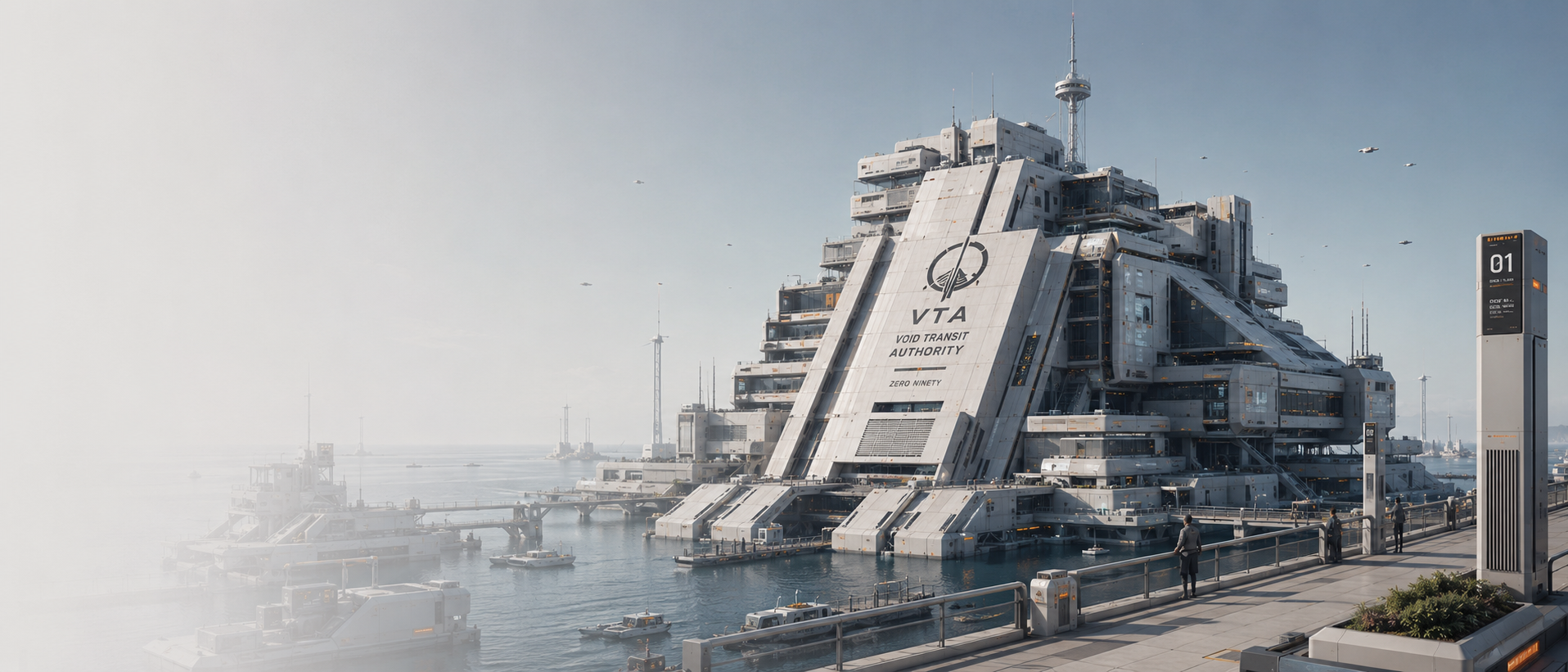
At the centre of Zero Ninety stands the headquarters of the Void Transit Authority, opened in 2240.
From here, VTA coordinates licensing, transit standards, gateway operations and the infrastructure that connects inhabited space beyond Earth.
0° 00′ 00″
90° 00′ 00″ E
Zero Ninety · EastRidge
A city without land.
Welcome to
We design, operate, and steward the infrastructure
that connects humanity beyond the gates.
Every gate. Every route. Every future.
0°00′00″ / 90°00′00″E
EastRidge
At 0° latitude and 90° east, the ocean became a city.
Built above the equatorial section of the Ninety East Ridge, Zero Ninety is the capital of EastRidge and the administrative home of the Void Transit Authority.
What began as a cluster of deep-ocean research, energy and launch platforms in the 22nd century grew into one of humanity’s largest permanent offshore settlements. Over the following three centuries, new districts, transport corridors, service platforms and civic infrastructure expanded outward across the Indian Ocean, forming the modular city that exists today.
Zero Ninety is not built on land.
A modular ocean city
Its districts rest on vast semi-submersible structures, held in position by distributed deepwater mooring systems anchored kilometres below to the ocean floor. Between them lie protected waterways, ports, maintenance basins and energy infrastructure.
The city’s outer perimeter integrates wave-control systems, marine power generation and navigation facilities designed for continuous operation in open ocean conditions.
Ocean infrastructure
The surrounding sea is not an obstacle to the city.
It is part of its infrastructure.
Deep-ocean thermal systems provide cooling and power. Surface solar arrays and wave-energy installations supplement the grid.
Waterways function as transport corridors, while submerged utility networks connect districts beneath the surface.
Void Transit Authority // HQ
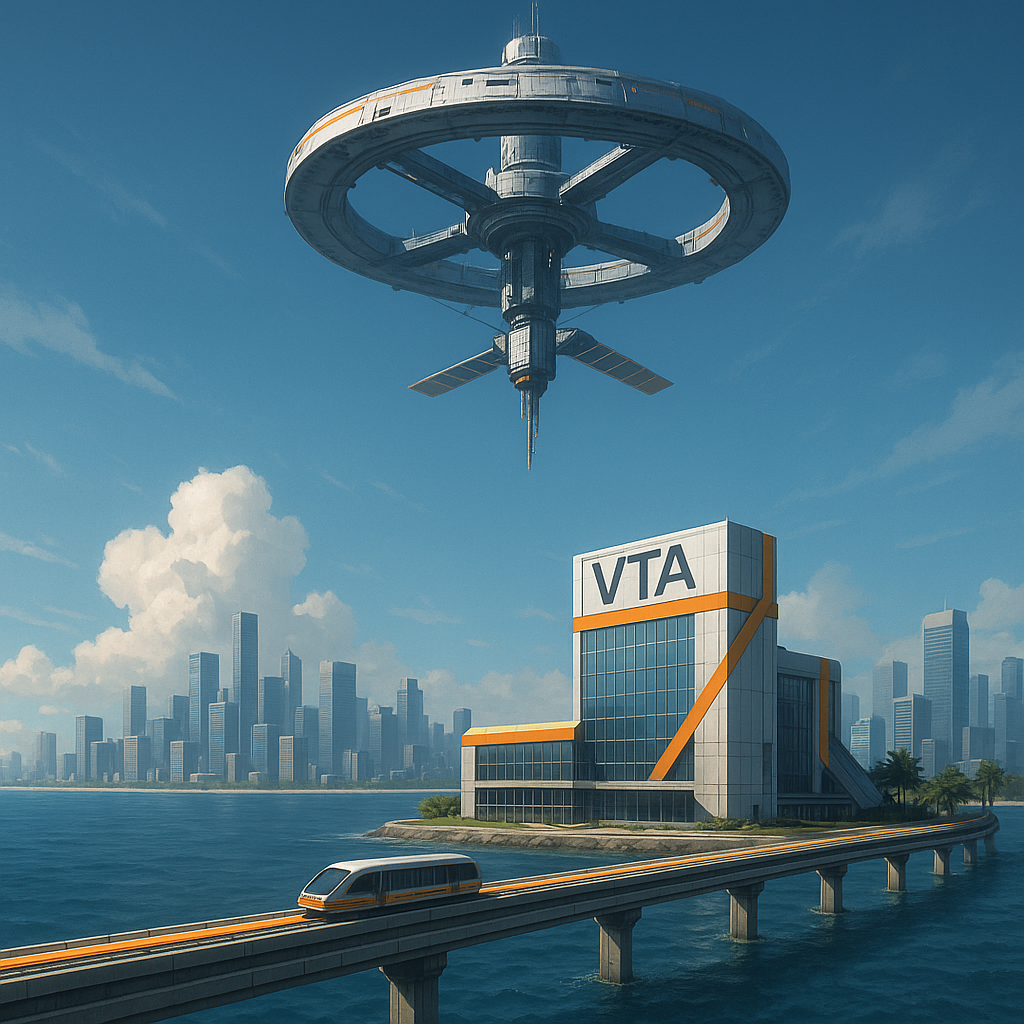
At the centre of Zero Ninety stands the headquarters of the Void Transit Authority, opened in 2240.
From here, VTA coordinates licensing, transit standards, gateway operations and the infrastructure that connects inhabited space beyond Earth.
0° 00′ 00″
90° 00′ 00″ E
Zero Ninety · EastRidge
A city without land.
Welcome to
We design, operate, and steward the infrastructure
that connects humanity beyond the gates.
Every gate. Every route. Every future.

01 // ABOUT
PUBLIC ORGANIZATIONAL OVERVIEW // CIVIL TRANSIT AUTHORITY
The Void Transit Authority is the common regulatory and coordination framework that allows a distributed intersystem transit network to function as one public system. It does not need to own every gate in order to define the standards, responsibilities, and trust that hold the network together.
MANY OWNERS.
MANY OPERATORS.
ONE NETWORK.
ORGANIZATIONAL RELATIONSHIP MAP
COMMON FRAMEWORK // NON-HIERARCHICAL NETWORKCOMMON FRAMEWORK
& PUBLIC OVERSIGHT
Policy · Law · Oversight
Own · Invest · Upgrade
Design · Build · Certify
Operate · Maintain · Respond
Use · Depend · Connect
Individual gates may be owned by states, consortia, or private entities, built by different manufacturers, and maintained by local operators. The VTA provides the common framework that makes them interoperable, auditable, and publicly accountable.
Ownership, manufacture, and local operation may be separate. Certification, network standards, and public oversight remain shared responsibilities under the VTA transit regime.
HEADQUARTERS
ZERO NINETY //NETWORK MODEL
DISTRIBUTED //JURISDICTION
CERTIFIEDACCESS
PUBLIC //02 // HISTORY
HISTORICAL REGISTRY // PUBLIC RECORD PENDING.
From the first stable corridor in Sol to a network spanning 217 connected systems, the history of intersystem transit is the history of human expansion beyond the gates.
EARLY CORRIDOR SCHEMATIC
06 ACTIVE GATES / ARCHIVE SCALE 01ARCHIVE CHRONOLOGY
Sol / Lunar Interface
ARCHIVE ENTRY • 001The first stable transit gate entered service within near-Earth infrastructure. Its successful operation proved that controlled corridor transit could be repeated safely and at civil scale.
Sol ↔ Alpha Centauri
ARCHIVE ENTRY • 002The first confirmed interstellar route connected Sol to Alpha Centauri. This link became the symbolic and operational beginning of the wider transit era.
Founding Mandate
ARCHIVE ENTRY • 003As routes, operators, and incidents multiplied, the Void Transit Authority was established as the primary regulatory and coordination body for transit governance, certification, and network oversight.
Unified Gate Compliance
ARCHIVE ENTRY • 004The first common compliance framework introduced shared standards for gate compatibility, pilot licensing, safety protocols, and emergency response coordination across multiple operators.
Frontier Phase
ARCHIVE ENTRY • 005Transit infrastructure expanded beyond the early core systems, transforming intersystem movement from an experimental network into the logistical backbone of settlement, trade, and colonial growth.
217 Connected Systems
ARCHIVE ENTRY • 006The contemporary VTA Network links 217 connected star systems and supports the routines of civil transit, regulated commerce, and long-range human presence beyond Sol.
03 // MISSION
PUBLIC PRINCIPLES // CIVIL TRANSIT DOCTRINE
The Void Transit Authority exists to ensure that intersystem transit remains safe, interoperable, accessible, and accountable — regardless of who builds the gate, owns the infrastructure, or operates the vessel.
FOUNDING DOCTRINE // FIVE PUBLIC PRINCIPLES
Every transit must end with a return.
Transit systems are certified around one principle: no route, schedule, or commercial priority outweighs the safe recovery of a vessel and its crew.
Interoperability before uniformity.
Gates may be built by different manufacturers, owned by different authorities, and maintained by different operators. Transit must remain interoperable across all of them.
The network must function even when it cannot communicate.
No gate should require immediate contact with a distant authority in order to protect life, suspend unsafe transit, or preserve essential service.
No safety signal is outside the network.
Distress records, route-state updates, safety notices, and emergency directives are carried with the same institutional seriousness as passengers and cargo.
Every transit leaves a record. Every authority leaves a trace.
Safety depends not only on preventing failure, but on preserving the evidence required to understand it. Certification records, incident archives, and black box reporting remain core to public trust.
04 // SERVICES
LICENSING // REGISTRATION // TRANSIT ACCESS // SAFETY
From pilot licensing and vessel registration to route access, safety records, and emergency coordination, VTA services provide a common interface to a distributed transit network.
SERVICE DIRECTORY // CIVIL ACCESS LAYER
Authorized to transit. Certified to return.
Apply for, renew, or verify a VTA pilot license. Licensing records define the classes of vessel and certified transit depth a pilot is authorized to operate.Every vessel. One recognized identity.
Register ownership, operating authority, vessel identity, and certified configuration within the VTA transit registry.Routes, permissions, and regulated access.
Review route eligibility, access restrictions, certification requirements, and temporary operating permissions for regulated transit corridors.Know the route before you enter it.
Access public gate schedules, departure information, route advisories, maintenance notices, and current transit restrictions.Trust requires a record.
Review public certification status, inspection records, safety notices, and compliance information for vessels, operators, and transit infrastructure.Emergency information is part of the network.
Access public emergency procedures, distress relay requirements, beacon guidance, and Search and Rescue coordination information.Verify before you transit.
Search public VTA records for licenses, registrations, certifications, regulatory notices, published incident reports, and other released transit records.
05 // CAREERS
CAREERS // PUBLIC RECRUITMENT OFFICE
The Void Transit Authority brings together pilots, engineers, analysts, investigators, operators, and public-service specialists working across the intersystem transit network.
Some careers begin at a gate. Others begin in a cockpit, an archive, a control room, or an incident report. All of them serve the same purpose: keeping transit safe, trusted, and available across distance.
THE NETWORK
DOES NOT RUN ITSELF.
NEITHER DOES TRUST.
CAREER TRACKS // PUBLIC DIRECTORY
Beyond the gate, procedure becomes judgment.
Licensed Transit Pilots operate vessels across certified routes and independent transit conditions, carrying passengers, cargo, data, and emergency traffic between connected systems.Every departure begins with someone watching the gate.
Gate Operations personnel coordinate local traffic, safety procedures, access conditions, and delegated operational decisions at transit facilities across the network.Standards matter only when someone enforces them.
Inspectors, certification specialists, and safety officers maintain the common technical and procedural framework that allows independently owned and operated infrastructure to function as one trusted network.Every failure leaves evidence. Someone has to read it.
Investigators, black-box analysts, and Search and Rescue specialists reconstruct incidents, preserve records, coordinate recovery, and turn failure into safer future transit.A distributed network survives on good decisions.
Analysts, route planners, data specialists, and archive personnel maintain the information systems that support route planning, advisory distribution, network records, and long-range operational awareness.